Fewer breakdowns, fewer breaches: how automation tackles machinery risk and downtime together

Regarding machinery safety and compliance, MATT IRELAND, Senior Manager of Legal and Regulatory Content at Ideagen Machine Safety, explains where manual processes fall short and how automation is addressing gaps across the machinery lifecycle.
Managing machinery safety and uptime is one of the most persistent operational challenges facing industries that rely on heavy equipment. Unplanned downtime, safety incidents and compliance failures carry serious consequences, financial losses, reputational damage, regulatory penalties and most critically, injuries to the workforce.
Yet across construction, mining, manufacturing and utilities, many organisations still manage machinery risk through manual processes: paper-based checklists, spreadsheet tracking, reactive maintenance schedules and compliance documentation scattered across filing cabinets and shared drives. These methods served their purpose for decades, but as fleets grow, regulations tighten and workforce expectations shift, the limitations of manual approaches are becoming harder to ignore.
Automation, specifically, digital platforms purpose-built for machinery safety and compliance, is offering a fundamentally different approach. Rather than digitising existing paper processes, these platforms are restructuring how organisations identify hazards, assess risk, schedule maintenance and demonstrate compliance.
The risks that manual processes struggle to contain
Machinery risk is multifaceted. Heavy equipment presents hazards from moving parts, electrical systems, hydraulics and high-pressure components. Operators and owners must navigate a web of legislation, regulations, standards and codes of practice, obligations that vary by jurisdiction, industry and machine type. A failure in any one area can trigger penalties, legal liabilities or operational shutdowns.
Beyond the regulatory layer, three operational risk areas consistently cause problems for organisations still relying on manual methods.
Inconsistent inspections and risk assessments
Every machine has a unique hazard profile. A 20-tonne excavator presents different risks to a concrete pump or an elevated work platform. Yet many organisations still use generic risk assessment templates across their entire fleet, relying on individual inspectors to identify machine-specific hazards. The result is inconsistency: different assessors evaluate the same machine differently, hazards are missed, and the quality of any given assessment depends entirely on whoever filled in the form that day. This subjectivity is one of the most underestimated risks in machinery safety management.
Reactive maintenance cycles
Without automated scheduling, maintenance tends to become reactive, machines are serviced when something breaks, not before. Many businesses struggle to track service intervals across a mixed fleet, leading to either over-servicing (wasting resources) or missed servicing windows (creating safety and reliability risks). The downstream effect is unplanned downtime, which is almost always more expensive and disruptive than scheduled maintenance.
Fragmented documentation
Accurate, up-to-date safety documentation is essential for demonstrating due diligence. But when records are spread across paper files, local drives and individual inboxes, pulling together a complete compliance picture for a single machine, let alone an entire fleet, becomes a significant undertaking. In the event of an incident or audit, organisations with fragmented documentation face an immediate credibility problem, regardless of how good their actual safety practices may be.
Why manual methods are hitting their limits
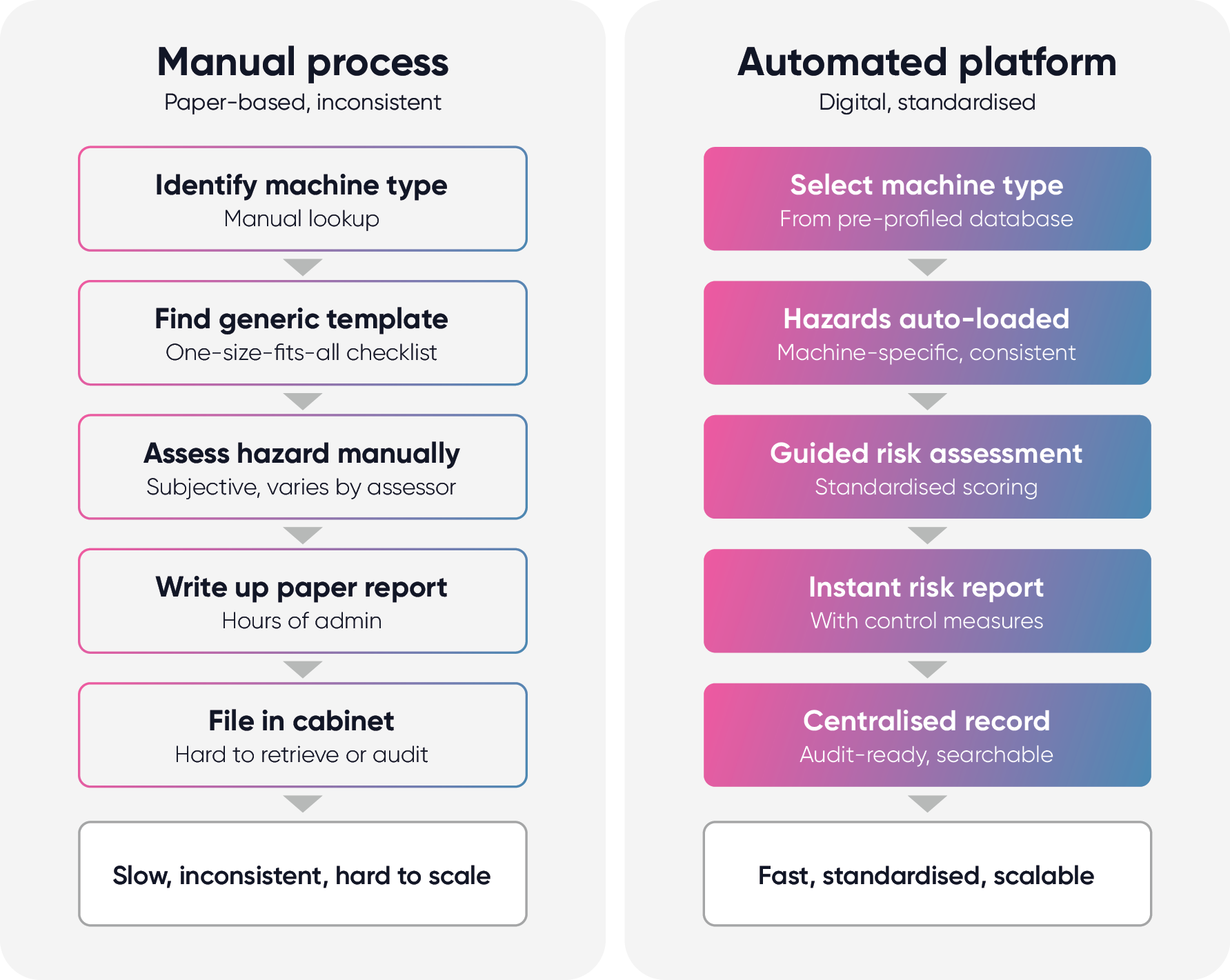
The issues above are not new; most safety managers could list them from memory. What has changed is the operating environment. Three trends are compounding the limitations of manual processes.
Fleet complexity is increasing
Organisations are running larger, more diverse fleets across more sites. A tier-two civil contractor that managed 30 machines from one depot a decade ago may now coordinate 150 assets across multiple projects, each with different principal contractor requirements. Manual tracking simply does not scale at this rate without exponential increases in administrative headcount.
Regulatory expectations are rising
Regulators are placing greater emphasis on demonstrable, systematic approaches to risk management. A completed checklist is no longer sufficient evidence of compliance, regulators want to see that the methodology behind the assessment is sound, that it accounts for machine-specific hazards and that the resulting control measures are appropriate and consistently applied. This is a standard that manual, template-based approaches struggle to meet.
Workforce dynamics are shifting
Experienced safety professionals who carried institutional knowledge about specific machines and site conditions are retiring. The workers replacing them need systems that embed that knowledge into the process itself, rather than relying on individual expertise that walks out the door at the end of a career.
How automation addresses these challenges
Automation in machinery safety is not about replacing human judgement, it is about providing a structured, consistent framework that supports better decision-making and removes the administrative friction that causes gaps in the first place.
Standardised, machine-specific risk assessments
The most significant shift automation enables is moving from generic templates to machine-specific assessments. Modern platforms maintain databases of pre-profiled machine types, each with its own hazard profile mapped to relevant legislative requirements. When an assessor initiates a risk assessment, the platform presents hazards specific to that machine type rather than relying on the assessor to identify them from scratch. This does not eliminate the need for human judgement, site-specific conditions still require expert input, but it ensures a consistent baseline that is far less susceptible to subjectivity or oversight.
Automated hazard control recommendations
Beyond identifying hazards, some platforms can recommend appropriate control measures based on the specific risk profile of a machine. Rather than leaving control selection entirely to the assessor, where experience levels, time pressure and personal judgement can produce wildly different outcomes, automation provides a standardised starting point. Controls such as guarding requirements, interlock specifications or PPE recommendations are matched to the identified hazards, ensuring a consistent and defensible approach across the organisation.
Proactive maintenance scheduling
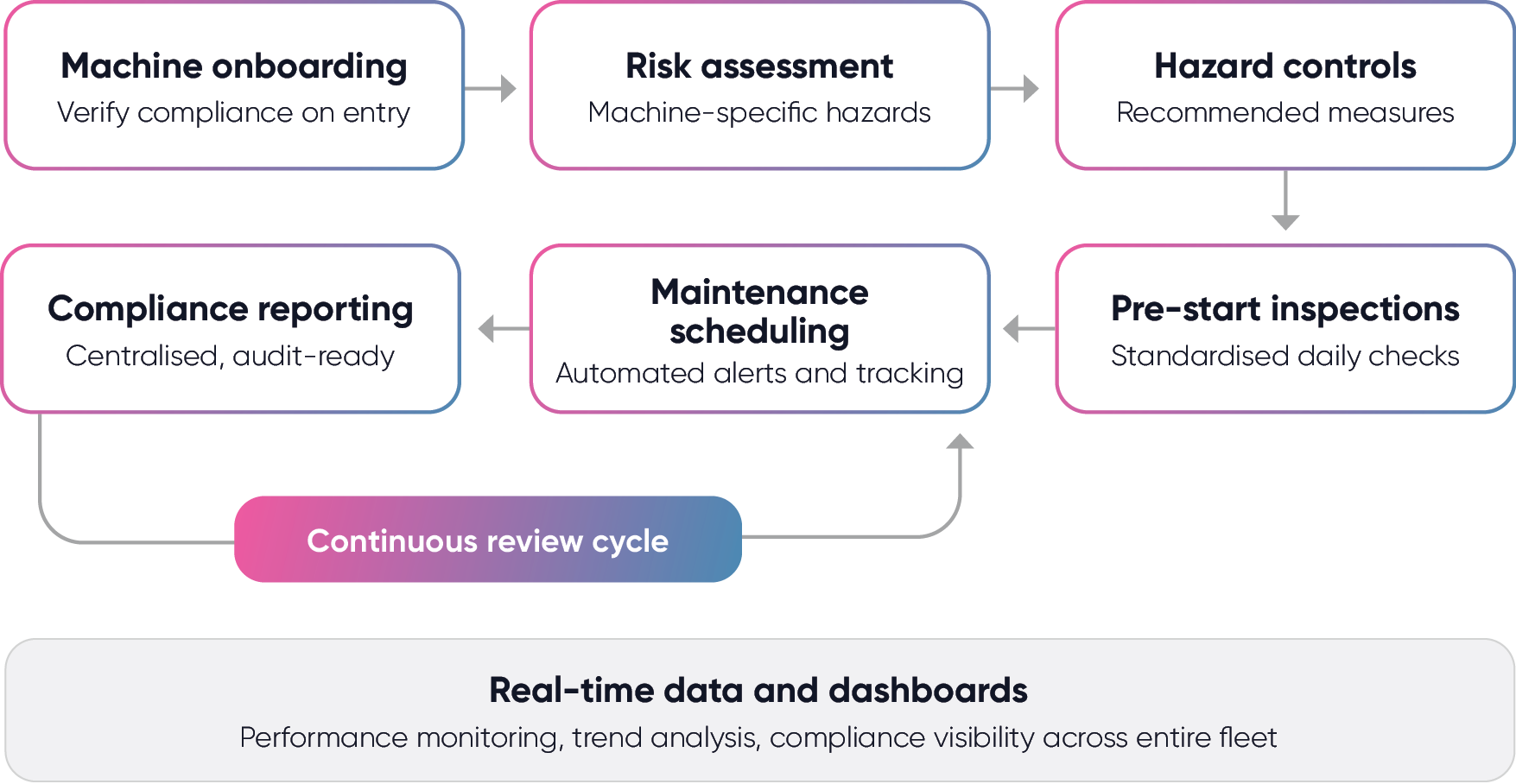
Automated maintenance management replaces the reactive cycle with planned intervention. Platforms track service history against manufacturer specifications and operational hours, triggering alerts when maintenance is due and assigning work orders to relevant personnel. The shift from “fix it when it breaks” to “service it before it fails” has a direct impact on both uptime and safety.
Streamlined compliance documentation
Digital platforms consolidate safety reports, maintenance logs, operator certifications and risk assessments into a single, searchable system. When an auditor or regulator requests evidence of compliance for a particular machine, the organisation can produce a complete history in minutes rather than days. This is not merely an administrative convenience, it fundamentally changes the organisation’s ability to demonstrate due diligence.
Subcontractor machinery onboarding
For principal contractors and site operators, managing the compliance status of subcontractor-owned machinery is a persistent headache. Automated onboarding systems can verify that incoming equipment meets safety standards before it enters site, pre-qualifying compliance documentation, logging certifications and flagging non-compliant assets. This shifts the compliance burden from manual checking at the gate to a systematic pre-qualification process.
Real-time visibility and reporting
Automated platforms provide dashboards and reporting tools that give safety managers a live view of fleet compliance status, outstanding maintenance tasks and inspection completion rates. This visibility enables proactive management rather than periodic reviews, and supports data-driven decisions about where to allocate safety resources.
Practical considerations for adoption
Transitioning from manual to automated machinery risk management is not an overnight exercise, and organisations considering the shift should approach it methodically.
The starting point is an honest assessment of current processes, specifically, where the biggest gaps exist between what the organisation does on paper and what actually happens on site. Automation delivers the most immediate value when applied to areas with the highest risk of inconsistency or non-compliance.
Scalability matters
The platform selected should accommodate fleet growth, multiple site operations and varying regulatory requirements without requiring a fundamental rearchitecture. Integration with existing business systems, fleet management, ERP, project management, is also a practical consideration that can determine whether automation simplifies workflows or adds another disconnected system to the stack.
Training is critical but often underestimated
The most sophisticated platform will fail if frontline workers, operators, supervisors and site managers, do not understand how to use it or, more importantly, why it matters. Adoption is strongest when the tools demonstrably make their daily work easier rather than adding another layer of bureaucracy.
Automation should be treated as an evolving capability rather than a one-time implementation
The data generated by automated systems, inspection trends, maintenance patterns, compliance gaps, is itself a valuable input for continuous improvement. Organisations that use this data to refine their processes will see compounding returns over time.
Looking ahead
The direction of travel is clear. As fleets grow, regulations evolve and the expectation of demonstrable compliance increases, manual machinery risk management will become progressively harder to sustain. Automation is not a silver bullet, it still requires competent people, sound processes and organisational commitment to safety. But it provides the infrastructure to manage machinery risk at a scale and consistency that paper-based methods cannot match.
For safety professionals evaluating their current approach, the question is no longer whether to automate, but how quickly the transition can be made, and which risks are accumulating in the meantime.
The air receiver registration duty most sites don't know they have
Air receivers are one of the quieter compliance gaps in Australian industry. Here's what the...
Mining and smelting complex implements pedestrian alert system
Designed to improve operator awareness, the system was deployed across a range of equipment...
Staying alive: how technology can minimise the risks of distracted driving
Having drivers on your team who don't keep their full attention on the road is dangerous on...