Ways manufacturers can make human-robot collaboration safer
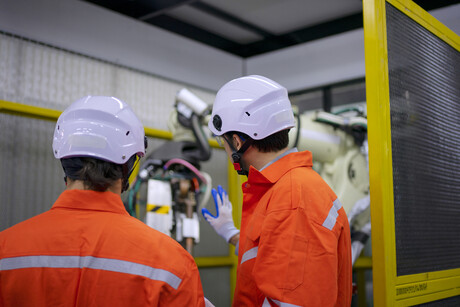
Improving the way robots predict human behaviour in shared industrial environments is key to human-robot collaboration safety, a recent review suggests.
As manufacturing moves toward Industry 5.0, production systems are becoming more human-centred — combining human creativity, judgement and dexterity with robotic precision, strength and speed. However, proximity between human workers and robots also raises safety issues. Now, a team of Australian and Chinese researchers set out to review how manufacturers can make human-robot collaboration safer, more adaptive and efficient.
What they found is that improving the way robots predict human behaviour in shared industrial environments is key to avoiding potential collisions, risks and injuries. The review, published open access in International Journal of Production Research (doi: 10.1080/00207543.2026.2639732), examines the major approaches used to predict human behaviour in human-robot collaboration.
These include data-driven models that learn from sensors and artificial intelligence, mechanism-based models built around physical motion and interaction rules, and hybrid approaches combining both. Although each method has strengths, the reviews argues that more integrated approaches are likely to be the most effective for future human-centric manufacturing systems.
“Industry 5.0 is about designing manufacturing systems around people as well as technology. By improving how robots predict human behaviour, we can move towards production environments that are not only more productive, but also safer, more adaptive and more human-centred,” said Dr Yunlong Tang, co-author of the review, Assistant Director of the Monash Centre for Additive Manufacturing, and Senior Lecturer in Mechanical and Aerospace Engineering and Materials Science and Engineering.
Several key challenges requiring attention are also pointed out by the review. These include:
- variability of human behaviour,
- limited scope of physical world models,
- absence of standardised multimodal datasets, and
- during collaboration, the need to more effectively consider human trust, workload and cognitive state.
A unified framework is proposed by the researchers to address these gaps. Such a framework that integrates multimodal data, physical world modelling, behaviour prediction and adaptive control. Further, combining physical models, sensor data and AI in ways that allow robots to respond more intelligently to human movement, intent and changing working conditions will be crucial to future progress, the review suggests.
As Industry 5.0 continues to evolve, these kinds of human-centred approaches are expected to play an important role in shaping the future of advanced manufacturing, the researchers suggest; the review highlighting how more intelligent prediction and planning tools could help manufacturers improve safety, strengthen collaboration between workers and robots, and build production systems that are more resilient, efficient and responsive.
The air receiver registration duty most sites don't know they have
Air receivers are one of the quieter compliance gaps in Australian industry. Here's what the...
Mining and smelting complex implements pedestrian alert system
Designed to improve operator awareness, the system was deployed across a range of equipment...
Fewer breakdowns, fewer breaches: how automation tackles machinery risk and downtime together
Automation promises to provide the infrastructure to manage machinery risk at a scale and...