Critical protection at altitude: why head protection must match the risk profile
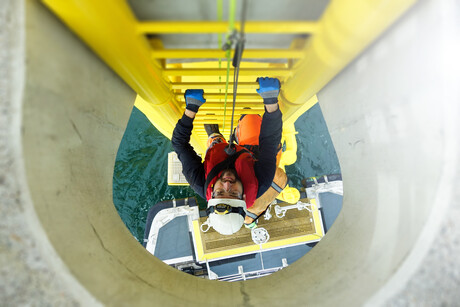
The updated standard AS/NZS 1801:2024 reflects modern understanding of how head injuries occur at height and sends a clear signal to duty holders: protective helmets must match the real risk profile of at-height work, not merely meet historical falling-object requirements. Working at Height Association CEO SCOTT BARBER runs us through it.
Working at height remains one of the most unforgiving risk environments across modern industry. Construction, utilities, energy, telecommunications, manufacturing and industrial maintenance all depend on workers operating above ground in dynamic, constrained and often unpredictable conditions. Despite decades of progress in fall prevention and arrest systems, serious head injuries continue to occur, frequently not from the fall itself, but from what happens during and after fall arrest.
While harnesses, anchors and engineered controls are rightly prioritised, head protection is often treated as a secondary consideration. In many workplaces, helmet selection remains anchored to legacy procurement norms rather than a clear understanding of contemporary injury mechanisms. With the release of AS/NZS 1801:2024, that gap is no longer defensible.
The reality of head injury risk at height
Falls from height remain a leading cause of fatal and life-altering injuries in Australia and New Zealand. Even where fall arrest or restraint systems function as designed, workers are still exposed to significant secondary hazards. Pendulum swings, uncontrolled rotation and collisions with surrounding structures are common outcomes of fall events.
A worker suspended following a fall may experience:
- Secondary and multiple head impacts
- Lateral or rear impacts during pendulum swing
- Rotational forces and off-axis strikes
- Helmet dislodgement due to poor retention
- Impact during assisted or self-rescue
These hazards occur regardless of whether a worker ultimately reaches the ground. Yet many workplaces continue to rely on traditional industrial hard hats that were never designed to manage these forces.
Where traditional hard hats fall short
Conventional industrial hard hats were developed around a vertical object-drop hazard model. Earlier versions of AS/NZS 1801 focused on protection against tools or materials falling from above, a risk profile aligned with ground-based construction rather than dynamic height work.
As a result, traditional hard hats typically lack:
- Side, front and rear impact protection
- Management of rotational energy
- Secure retention during dynamic movement
- Low-profile geometries suitable for confined or cluttered environments
Common design limitations include single-axis impact testing, basic or optional chin straps, bulky shells prone to snagging, and suspension-only energy management systems. In the context of fall arrest, these shortcomings are no longer theoretical; they are well-documented contributors to injury severity.
What are the AS/NZS 1801:2024 changes, and why it matters
The 2024 revision of AS/NZS 1801 represents the most significant update to industrial helmet standards in decades. Rather than simply refining existing requirements, it introduces a more nuanced, hazard-based framework that acknowledges different risk environments.
The introduction of Type 4 helmets
The most important change for working-at-height environments is the introduction of Type 4 helmets. These helmets are specifically intended to address fall-related head injury risks through:
- Multi-directional impact attenuation
- Enhanced helmet stability
- Stronger retention system performance
- Reduced likelihood of dislodgement during a fall
For any task involving fall risk, even where fall arrest systems are in place, Type 4 helmets more accurately reflect the hazard profile than traditional Type 1 industrial helmets.
A shift in design intent
The introduction of Type 4 helmets signals a deliberate shift away from a ‘falling object’ paradigm towards a ‘fall consequence’ paradigm. Injury data consistently shows that serious head injuries at height occur due to lateral and rear impacts, rotational forces and helmet displacement, not simply vertical strikes.
Type 4 helmets explicitly recognise these mechanisms. They permit and anticipate the use of energy-attenuating liners and secure retention systems designed to keep the helmet correctly positioned throughout dynamic movement and fall events. Importantly, Type 4 does not replace other helmet categories; it clarifies that working at height is a distinct risk context requiring a different protection envelope.
Updates to other helmet categories
AS/NZS 1801:2024 also modernises other helmet types. Type 1 helmets now allow greater design flexibility, including soft energy-absorbing liners and a broader range of shell materials. While this enables lighter and more comfortable helmets, Type 1 still lacks mandatory multi-directional impact requirements and remains unsuitable for height-risk applications.
Type 3 helmets have been aligned with AS/NZS ISO 16073.5 for bushfire and wildland firefighting, reinforcing that these helmets are not intended for industrial height work.
The removal of the mandatory stiffness test allows for lighter materials and more flexible shells, but stiffness alone does not equate to lateral impact protection. The standard makes clear that performance, not material rigidity, is the critical factor.
Why climbing-style helmets already align with the standard’s intent
Many climbing-style and industrial mountaineering helmets already align closely with the intent of AS/NZS 1801:2024, particularly for height-exposed workers. These helmets are often dual-certified to AS/NZS 1801 (earlier editions) alongside EN 12492 or EN 397 Type 2, standards developed specifically for fall-related hazards.
Key advantages include:
Multi-directional impact protection
Technical helmets are designed to attenuate impacts around the entire circumference of the head, not just the crown.
Secure retention systems
Integrated four-point chin straps, typically rated to at least 150 N, ensure the helmet remains in place during falls, swings, rescues and high-movement tasks.
Low-profile, snag-resistant design
Compact geometries reduce the risk of catching on scaffolding, steelwork or confined structures.
Energy-absorbing liners
Expanded foam liners and composite shells manage energy more effectively than suspension-only designs.
Accessory integration
Purpose-designed mounts for visors, hearing protection, lighting and communications allow accessories to be fitted without compromising helmet performance.
Legal and regulatory implications
Under Australian and New Zealand WHS legislation, PCBUs are required to ensure PPE is fit for purpose, suitable for the hazard, and does not introduce additional risk. With AS/NZS 1801:2024 now formally recognising multi-directional impact protection as a helmet class, continuing to issue traditional hard hats for height-exposed work may be difficult to justify where better-matched options exist.
In the event of an incident, failure to provide appropriate head protection may be interpreted as a breach of the primary duty of care, inadequate risk management or non-compliance with PPE selection obligations.
Managing the transition
While Type 4 certified helmets are not yet widely available in the local market, internationally certified helmets such as EN 397:2025 Type 2 and EN 12492 continue to offer a practical, defensible pathway. When supported by documented risk assessments and performance equivalence, these helmets allow duty holders to address known risks now rather than waiting for certification availability to catch up with standard evolution.
| Selection Criterion | Type 1 (AS/NZS 1801:2024) | Type 2 (AS/NZS 1801:2024) | Dual-Certified AS/NZS 1801:1997 + EN (eg, EN 12492 / EN 397 Type 2) | AS/NZS 1801:2024 Type 4 (when available) |
|---|---|---|---|---|
| Primary hazard addressed | Falling objects (vertical impact). | Falling objects plus high-temperature exposure. | Falls and multi-directional head impacts, with continued compliance to legacy AS/NZS 1801. | Falls and multi-directional head impacts (explicitly). |
| Foreseeable fall risk | Not reasonably foreseeable or fully controlled. | Low or residual; heat risk dominates. | Reasonably foreseeable (slips, trips, loss of balance, partial falls). | Reasonably foreseeable (design intent). |
| Impact direction coverage | Crown (top) impact only. | Crown (top) impact only. | Crown, side, front, and rear impacts (via EN certification). | Crown, side, front and rear impacts (mandated). |
| Helmet stability during movement or fall | Limited — relies on suspension harness; chinstrap optional. | Limited — similar to Type 1. | High stability — close-fitting shells and mandatory retention under EN standards. | High stability — dynamic retention and stability testing required. |
| Retention system | Chinstrap optional (≥15 mm if fitted). | Chinstrap optional; heat-rated materials. | Mandatory chinstrap under EN 12492 / EN 397 Type 2. | Mandatory chinstrap with performance testing. |
| Thermal/heat environment suitability | General environments. | High-temperature and ignition risk environments. | Suitable for general and moderate heat; not for molten metal exposure. | General environments; not intended for molten splash. |
| Ventilation and comfort | Generally good ventilation. | Restricted ventilation. | Often more enclosed; comfort dependent on liner and vent design. | Likely enclosed; comfort dependent on manufacturer design. |
| Availability in AU/NZ market | Widely available. | Widely available. | Currently available and widely used in height-related work. | Limited or unavailable at present. |
| Regulatory alignment | Meets AS/NZS 1801:2024. | Meets AS/NZS 1801:2024. | Meets AS/NZS 1801:1997 plus higher EN performance requirements; supports risk-based justification. | Meets AS/NZS 1801:2024 intent for height protection. |
| Reasonably practicable justification | Appropriate where fall risk is not foreseeable. | Appropriate where heat risk outweighs fall risk. | Reasonably practicable interim control where fall risk exists and Type 4 helmets are unavailable. | Preferred option when available and suitable. |
Safety from the neck up
Working at height is not just about preventing falls; it is about managing what happens when falls occur. Collisions, swings and impacts are not anomalies; they are predictable outcomes that demand appropriate protection.
Head protection deserves the same level of scrutiny applied to harnesses, anchors and lifelines. Helmets that manage multi-directional impacts and remain in place under dynamic load are not a luxury. They are an evidence-based response to a clearly defined risk.
The question for industry is no longer whether upgrading head protection is possible, but whether continuing to rely on outdated models is acceptable.
The fire-protection potential of mycelium leather
Made from fungal networks cultivated using agricultural waste and water, could this wildfire...
The day after certification: why the right glove can become the wrong glove
A glove may be certified once, but it is tested by the work every day. Here's why safety...
Could Australia's use of this machine identify silicosis before damage occurs?
Introduced in Australia in 2024, the machine uses a simple breathing test to capture microscopic...