Safety at work is a serious job — using creativity and data to shift behaviour in South Australia
In April 2026, SafeWork SA launched its first major public awareness campaign in more than 15 years — ‘Safety at work is a serious job’. The regulator’s Executive Director GLENN FARRELL takes us through it.
Work health and safety (WHS) regulators are often challenged to find the right balance between enforcement and education. While compliance activity remains essential in deterring unsafe practices, sustained improvements in workplace safety depend equally on influencing attitudes, awareness and everyday decision-making.
Running through to December, the campaign represents a strategic shift towards a more integrated approach to harm prevention, combining targeted messaging, behavioural insight, data-led priorities and traditional regulatory activity.
The campaign has so far been well received by the WHS community, according to early analytics. For WHS professionals, the campaign offers a compelling case study in how communications can be used alongside compliance to drive meaningful safety outcomes.
A campaign grounded in evidence
At the heart of the campaign is a simple premise: focus on the hazards causing the most harm.
SafeWork SA identified three priority risks — falls from heights, roll-away vehicles, and slips and trips (particularly ones resulting from spills) — using a combination of regulator notifications and compensation claims data from ReturnToWorkSA. Together, these hazards have contributed to 21 deaths and 496 serious injuries in South Australia over the past four years, underscoring their persistent and often preventable nature.
The broader economic and human cost is significant. ReturnToWorkSA data shows:
- About 3600 injury claims annually in South Australia related to falls, slips and trips
- These claims cost approximately $105 million each year
Falls alone account for roughly 1100 claims per year costing $32 million, while slips and trips contribute 2500 claims costing $73 million annually.
These figures reinforce what WHS professionals already understand: common hazards, when unmanaged, produce disproportionate harm.
While the number of incidents related to roll-away vehicles are lower than other hazards, the result can be catastrophic in terms of death, severity of injuries and resultant property damage
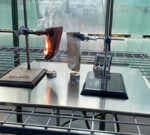
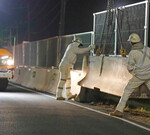
Roll-aways can occur with any type of mobile plant and can occur on worksites, car parks, maintenance yards or when a vehicle is parked on the side of the road.
Translating risk into relatable messaging
A key challenge in safety communication is cutting through familiarity. Workers know the risks — yet incidents still occur. SafeWork SA’s campaign addresses this by reframing well-known hazards through a creative lens.
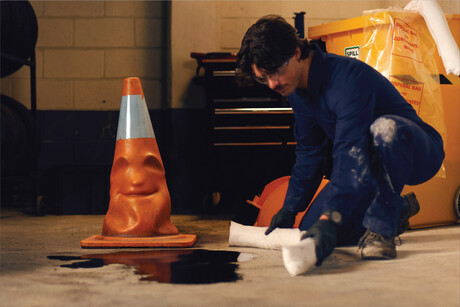
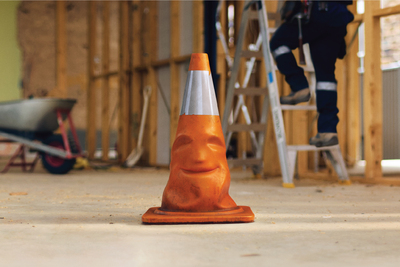
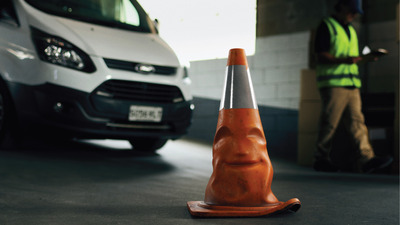
Enter Stanley, an animated talking traffic cone.
Using a universally recognised symbol of safety, the campaign delivers practical advice across the three hazard areas through short, memorable messages:
- Falls: “Check it’s fine before you climb.”
- Roll-aways: “Avoid a mistake, engage the brake.”
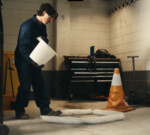
- Spills: “You know the drill, clean up that spill.”
While the tone is light, the intent is serious. Stanley’s character — gruff but knowledgeable — was designed to resonate with workers, particularly in higher-risk industries such as construction, transport and manufacturing.
Independent market testing with target audiences confirmed the approach was effective. Participants found the concept novel, engaging and easy to recall — critical components in influencing behaviour in high-risk environments.
Why creativity matters in WHS
For seasoned WHS professionals, the idea of using an animated cone may seem unconventional. But behavioural science supports the approach.
Repetition and recall are key drivers of behavioural change. Traditional safety messaging can blend into the background, particularly for experienced workers. By contrast, distinctive creative devices — like a talking traffic cone — create a “pattern interrupt”, increasing the likelihood that the message will be noticed, remembered and acted upon.
Importantly, the campaign does not trivialise risk. Instead, it uses accessible storytelling to reinforce practical controls:
- Verifying work surfaces are suitable and implementing effective controls before working at height
- Ensuring vehicles are immobilised and secured against unintended movement before exiting or undertaking work nearby
- Maintaining housekeeping standards to eliminate slip hazards
The goal is not to replace formal training or systems but to reinforce them in everyday decision-making.
The hazards in focus
Falls from heights
Falls remain one of the leading causes of workplace fatalities nationwide, accounting for approximately 13% of worker deaths between 2022 and 2024.
In South Australia alone, SafeWork SA recorded 300 notifications involving serious falls between 2022 and 2025, resulting in:
- 12 fatalities
- 288 serious injuries
Notably, about half of fatal falls occur from heights of three metres or less, highlighting that even low-level work presents significant danger.
The construction sector remains the most affected, followed by transport, manufacturing and agriculture.
Regulatory response has included strengthened compliance campaigns and legislative reform. A key change is the reduction of the high-risk construction work threshold from three metres to two metres, aligning South Australia with national model WHS laws. This change came into effect on 1 July this year and reflects the reality that risk is not confined to extreme heights.
Slips, trips and spills
Often underestimated, slips and trips are the second leading cause of workplace injury after hazardous manual tasks.
Between 2022 and 2025, SafeWork SA received 196 notifications related to slips and trips, resulting in:
- 5 fatalities
- 191 serious injuries
The causes are typically mundane but persistent:
- Poor housekeeping
- Wet or uneven surfaces
- Inadequate lighting
- Obstructed walkways
These incidents occur across a wide range of industries, from construction to health care, and frequently involve simple, preventable failures.
Roll-away vehicles
Although less frequent, roll-away incidents can have catastrophic consequences.
SafeWork SA recorded 42 roll-away incidents over five years, leading to:
- 4 fatalities
- 17 serious injuries
- 13 cases of significant property damage
These incidents highlight critical failures in basic controls:
- Not engaging park brakes
- Inadequate maintenance
- Failure to use wheel chocks
- Unsafe parking on inclines
The severity of outcomes reinforces the importance of procedural compliance and system design in mobile plant safety.
Integrating communication with compliance
The campaign does not operate in isolation. It complements a significant uplift in SafeWork SA’s compliance and enforcement activity.
In 2024–25, the regulator:
- Conducted 7715 site visits (up from 5122 in 2022–23)
- Issued 5238 statutory notices
- Achieved 18 convictions, the highest in 10 years
- Secured $2.37 million in fines from court prosecutions
This increased presence is correlating with improved safety outcomes. Over the same period, serious injury notifications have declined from 766 in 2022–23 to 356 in 2024–25.
For WHS professionals, this demonstrates the value of a dual approach: visible enforcement combined with proactive education and communication.
Reaching workers where they are
The campaign uses a multi-channel strategy to maximise reach and engagement:
- Social media and digital platforms
- On-demand television
- Print advertising
- Outdoor billboards and bus shelters
- Industry engagement and events including the AIHS National Health & Safety Conference in June
A dedicated campaign hub on the SafeWork SA website provides access to resources, guidance and reporting channels, while stakeholder kits allow businesses to share campaign materials internally.
This approach recognises that safety messaging must extend beyond the workplace and into everyday contexts where workers consume information.
The role of workplaces
While the regulator can set expectations and raise awareness, workplaces remain the frontline of safety.
The campaign reinforces core legal duties
For businesses:
- Identify hazards and control risks so far as reasonably practicable
- Provide safe systems of work and adequate training and supervision
- Maintain equipment and ensure safe access and egress
For workers:
- Follow procedures and use PPE
- Report hazards
- Take reasonable care for their own safety and others
In practice, this means embedding safety into routine operations — from pre-start checks to housekeeping, vehicle immobilisation and working at heights protocols.
Early results and future potential
Although still in its early stages, the campaign is showing strong engagement metrics across digital and media channels. Feedback indicates that Stanley’s character and the campaign’s tone are resonating with target audiences.
This level of engagement is significant. Awareness is the first step toward behaviour change, and sustained exposure over the campaign period is expected to reinforce safer practices.
**************************************************
A broader lesson for WHS practice
The ‘Safety at work is a serious job’ campaign highlights an important evolution in WHS practice: safety is not just about rules and enforcement — it is also about influence.
For WHS professionals, the campaign offers several key takeaways:
1. Data should drive priorities
Targeting the hazards that cause the most harm ensures resources have maximum impact.
2. Communication matters
Clear, memorable messaging can reinforce safe behaviours at scale.
3. Creativity can enhance engagement
Distinctive campaigns can cut through complacency and make safety messages stick and be used by those that can influence.
4. Integration is critical
The most effective strategies combine communication, compliance and education.
5. Consistency builds culture
An “always on” approach keeps safety front of mind.
**************************************************
Keeping the focus on what matters
Ultimately, the campaign’s message is simple: Safety at work is a serious job.
Behind every statistic is a person — a worker who did not return home, or whose life changed in an instant. By focusing on common but high-impact risks, and delivering practical advice in an engaging way, SafeWork SA is working to ensure fewer South Australians experience those outcomes.
For WHS professionals, the campaign reinforces a shared goal of embedding safety into every task, every decision and every workplace.
Because when safety becomes second nature, everyone benefits.
222 in 2025 — "confronting" data reveals highest annual worker fatalities since 2012
Safe Work Australia has published the Key Work Health and Safety Statistics Australia 2026,...
Hospital trials paid worker exercise
Around 100 Nepean Hospital workers will take part in a 12-month trial, involved in activities...
Five emerging transport leaders create utilities digital platform solution
The team set out to solve one of construction's most persistent problems: accessing accurate...