Roof anchor points: getting inspection and recertification right
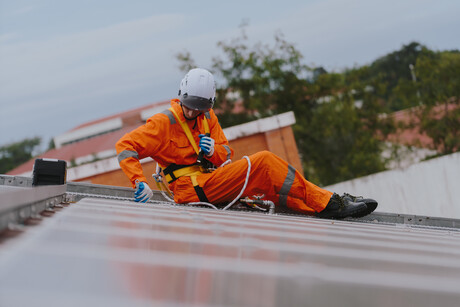
Falls from a height killed 24 Australian workers in 2024, making falls the second largest contributor to workplace deaths at 13% of all worker fatalities. Behind those deaths sit around 7800 serious workers compensation claims for falls from a height in a single year.1 The numbers have barely moved in a decade, and they explain why the roof anchor point deserves far more attention than it usually gets. Taking a deep dive into the topic, JAIME GUNTON — Director of Height Safety Central — covers revised standards, annual inspections, the problems that slip past a visual check, and some practical steps for workers to take before clipping on — together with those a building’s owner should take to bring a neglected system back into compliance.
An anchor point is the one component of a fall protection system that cannot be swapped out on the morning of the job. Harnesses and lanyards travel with the worker and are inspected as personal equipment. The anchor stays on the roof through summers, hailstorms and coastal winters, and it is only as good as its last inspection. Yet on real buildings, anchors are routinely installed, signed off and then forgotten. Ask anyone who inspects roofs for a living: it is common to walk onto a roof where the anchors are years overdue for recertification, or where nobody can produce a record showing the system was ever certified at all.
The duty here is not ambiguous. Under the model WHS Regulations, a person conducting a business or undertaking must manage the risk of falls and must maintain the equipment provided to control that risk so it remains effective. Safe Work Australia’s code of practice on managing the risk of falls makes the same point in plain terms: a fall arrest system is only a control measure while every component of it, anchorage included, remains in serviceable condition.2
Two revised standards have just raised the bar
In late 2025, Standards Australia published new editions of both documents that govern this space. AS/NZS 1891.4:2025, now titled ‘Personal equipment for work at height, Part 4: Selection, use and maintenance’, replaces the 2009 edition that most inspection regimes were built on.3 AS 5532:2025 replaces the 2013 manufacturing standard for single-point anchor devices.4
Two changes matter most for building owners and facility managers.
First, the inspection clock is now firmly annual. The old edition allowed a manufacturer to specify extended intervals between formal inspections of installed fall arrest devices, in some cases up to five years. That provision is gone. Installed systems now sit on a 12-month formal inspection cycle carried out by a competent person, and any system still riding on a longer manufacturer-approved interval needs to be brought back to an annual baseline. The six-monthly inspection regime for harnesses, lanyards and other personal equipment has not changed.3
Second, anchor ratings are now more precise. AS 5532:2025 formalises four rating levels, 12, 15, 18 and 21 kN, in place of the single baseline of the 2013 edition, and it explicitly addresses two-person anchors, which must achieve 21 kN and pass two drop tests on the same device. Proof load procedures have been tightened as well, with load applied in increments and anchor displacement measured both during and after the test.4 Anchors certified under the 2013 edition do not need to be pulled out, but at their next scheduled test they should be assessed against the current procedures, and any new installation should be specified against the new rating framework.
What a proper annual inspection covers
A competent inspection is organised around the type of anchor, because each type fails in its own way.
Mechanical anchors, the surface mounted and bolt-through units found on most metal roofs, are checked for deformation of the body and eye, cracking around fixing points, corrosion on and beneath the base plate, loose or missing fasteners, and damage to the roof sheeting that the anchor loads when it arrests a fall. Purlin fixed units also need fastener condition and tension verified, not just glanced at.
Chemical anchors, the adhesive set eyebolts common on concrete structures, are checked for rotation or movement in the socket, the condition of the adhesive line, and cracking or spalling in the surrounding concrete.
Webbing and other soft anchorage components, along with the static lines that link anchors into horizontal systems, are checked for ultraviolet degradation, abrasion, cut strands, stitching damage, chemical contamination and correct line tension at the indicators.
Beyond the hardware, the inspection covers the system as a whole: end terminations, intermediate brackets, signage, identification tags and the documentation that ties it all together.
Why corrosion and substrate problems slip past a visual check
The uncomfortable truth about anchor inspection is that the most dangerous defects are the ones that cannot be seen from the roof surface. The structural interface, where the anchor meets the building, is usually concealed: under flashing, beneath the base plate, inside the roof space or set into concrete. That is exactly where damage concentrates.
Dissimilar metals are a standing hazard on Australian roofs. A stainless steel anchor fixed through coated steel sheeting, with moisture present, sets up galvanic corrosion that attacks the sheeting or fasteners around the fixing point while the anchor itself still looks new. Coastal chloride exposure and industrial atmospheres accelerate the process. On older buildings the substrate itself deteriorates: timber battens and rafters rot around bolts, and concrete cracks and spalls.
The margins involved leave no room for optimism. Fall arrest equipment is designed around limiting the force transmitted to the body during arrest to 6 kN, yet peer-reviewed drop testing has shown that energy absorbers can exceed 7 kN when arresting heavier workers.5 Those forces assume the anchor delivers its full rated strength. An anchor weakened at a concealed interface may hold a worker’s weight during a casual pull and still fail under arrest loading.
This is why recertification cannot be reduced to a walk past with a clipboard. Where the history of an anchor is solid, the 2025 revision takes a sensible documentation-led approach: an anchor fixed by multiple fasteners that was proof loaded at installation, installed to the manufacturer’s specification over a structure verified as adequate, and maintained since, may not require annual proof loading.3 Anchors that rely on a single fixing are not covered by that concession and still need pull testing every 12 months. Where that paper trail does not exist, load testing and physical verification come back into the picture, because there is nothing else to rely on.
**************************************************
The documentation a worker should see before clipping on
Before anyone connects to an anchor, four things should be available and current.
1. Identification
Each anchor should carry a durable label or tag with a unique identifier and its rating, matching the system layout plan.
2. Installation certification
A record of who installed the system, to what specification, and confirmation that it was proof loaded or otherwise verified at handover.
3. A current inspection record
Dated within the last 12 months, identifying the competent person who carried it out and stating that the anchor passed.
4. System documentation
The layout drawing, the number of users each anchor or line supports, the equipment required to use it, and rescue considerations.
If any of these cannot be produced, the anchor should be treated as unverified and not used. On a roof, ‘probably fine’ is not a rating.
**************************************************
**************************************************
Bringing a neglected system back into compliance
A building owner who discovers undocumented or overdue anchors has a manageable problem, and solving it usually runs in five steps.
1. Audit
Walk the roof and register every anchor and line: location, type, apparent condition, markings.
2. Recover the history
Original installers, building files and past maintenance contractors often hold certification that the current owner has simply never seen.
3. Inspect and test
A competent person carries out a full inspection, and where installation records cannot be reconstructed, proof testing is used to establish the integrity of what is there.
4. Decide what stays
Some anchors will recertify cleanly. Others are better decommissioned and replaced, and on older undocumented systems replacement is sometimes cheaper than the engineering effort needed to validate the existing hardware, particularly where the layout would not meet current practice.
5. Tag, record and repeat
Every surviving anchor is tagged, the register is completed, and the system enters the annual cycle with a named owner who holds the records, schedules the inspections and requires contractors to sight the documentation at induction.
**************************************************
None of this is onerous next to the alternative. An anchor point is the one asset on a building bought specifically for the worst day of someone’s working life. Treating its inspection and recertification as routine asset management, on a firm annual cycle, with documentation a worker can actually see, is the difference between a fall protection system and a row of decorative eyebolts.
1. Safe Work Australia. Key work health and safety statistics, Australia 2025. Canberra: Safe Work Australia; 2025. https://data.safeworkaustralia.gov.au/insights/key-whs-statistics-australia/latest-release
2. Safe Work Australia. Managing the risk of falls at workplaces: model code of practice. Canberra: Safe Work Australia; 2021. https://www.safeworkaustralia.gov.au/doc/model-code-practice-managing-risk-falls-workplaces
3. Standards Australia. AS/NZS 1891.4:2025, Personal equipment for work at height, Part 4: Selection, use and maintenance. Sydney: Standards Australia; 2025. https://www.standards.org.au/standards-catalogue/standard-details?designation=as-nzs-1891-4-2025
4. Standards Australia. AS 5532:2025, Manufacturing requirements for single-point anchor device used for harness-based work at height. Sydney: Standards Australia; 2025. https://www.standards.org.au/standards-catalogue/standard-details?designation=as-5532-2025
5. Goh YM, Love PED. Adequacy of personal fall arrest energy absorbers in relation to heavy workers. Saf Sci. 2010;48(6):747–754. doi:10.1016/j.ssci.2010.02.020
Is operator competency keeping pace with EWP technology?
When it comes to workplace safety, it's easy to think of EWP operator competency as a box...
Mobile elevating work platform training program gets an upgrade
It's in response to revised Australian Standards for the manufacture and operation of mobile...
'Stanley the cone' targets three common workplace hazards
Between April and December 2026, SafeWork SA's Stanley the cone campaign will provide advice...