Could 'swarms' of giant cyborg cockroaches be the future of disaster sites care?
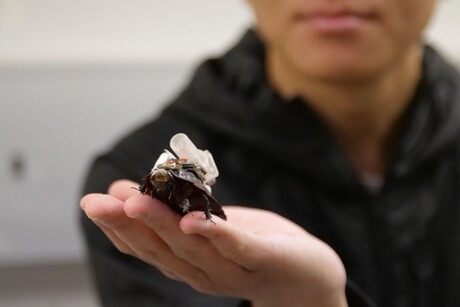
Australian researchers have fitted cameras and miniature medical injectors to cyborg cockroaches to make them capable of administering supervised emergency care.
To assist people trapped in collapsed buildings, caves or other places too dangerous for rescuers to reach, Australian researchers have fitted cameras and miniature medical injectors to ‘swarms’ of cyborg cockroaches who, they say, are capable of administering supervised emergency care.
Developed by University of Queensland biorobotics researchers working with biomedical engineers at the University of New South Wales (UNSW), about the ‘paraborgs’, UQ biorobotics engineer Dr Thang Vo-Doan said their research transforms the cyborg insect from a mobile sensor into a tiny rescue platform, while critical medical decisions remain under human control.
“Cyborg insects have been designed for ‘search and explore’ missions for the past couple of decades,” Vo-Doan said. “We wanted to take the next step. Once they find someone, can they actually help?”
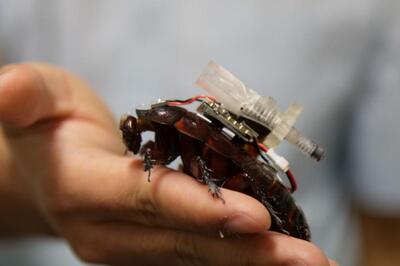
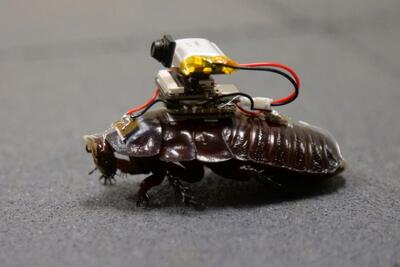
North Queensland giant burrowing cockroaches (Macropanesthia rhinoceros) were equipped with lightweight electronics and either cameras for visual feedback or remotely activated auto-injection systems custom-made for the species.
“Augmenting their natural biomechanics could allow these cyborg insects to deliver timely emergency assistance when direct access to people trapped in narrow, debris-filled spaces isn’t possible,” Vo-Doan said.
The paraborgs achieved 95% success with close-range injection — positioned within 15 centimetres of the target — in proof-of-concept testing at UQ’s School of Mechanical and Mining Engineering, the university said, with the complete navigation-and-injection task succeeding 72% of trials.
“The cyborg insect has to navigate to the target, position itself accurately and remain stable enough to perform the injection,” UQ PhD candidate Hai Nhan Le said. “A lot of people might not like the sight of a giant cockroach scurrying towards them, but if you’re trapped in rubble or stuck in a cave and need help, it could make a real difference between life and death.”
The longer-term vision was to deploy swarms of specialised cyborg insects, with individuals performing complementary roles, Vo-Doan said. “Some could carry cameras and environmental sensors, while others could carry specialised emergency or medical equipment,” Vo-Doan added.
“The vision is not to replace first responders, but to give them another way to see, reach and potentially help people when direct access is impossible,” Vo-Doan said. “Hopefully, within the next 5 to 10 years, we could see cyborg insect rescue teams deployed to help people in real emergencies, provided we have the resources to accelerate the research and field testing.”
The study was published open access in Advanced Science and you can read it at doi.org/10.1002/advs.76973.
AI system seeks to prepare firefighters for megafire conditions
Part of a five-year partnership between UNSW and Fire and Rescue NSW, the scenario-modelling...
Five ways to reduce fire risk of lithium-ion batteries in healthcare settings
The use of lithium-ion batteries in health care will continue to grow as technology advances, but...
Portable fire protection equipment at any time, day or night
An Australian manufacturer and wholesaler of portable fire protection equipment has a network of...