How technology is improving onsite sanitation and productivity
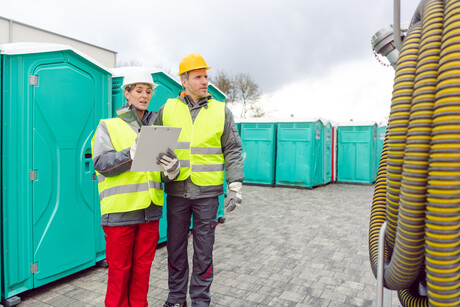
For too long, portable sanitation on construction and mining sites has been considered as simply a box-ticking exercise — a health and safety issue that ensures the necessary facilities are available on site and operational. Yet now, as SCOTT RAWSON — founder and Managing Director of portable facilities provider Instant Products Group — explains, portable facilities are increasingly being considered an on-site amenity, contributing not only to health and safety requirements, but playing a role in maintaining productivity.
For decades, portable sanitation was fairly crude, especially in remote areas where access and ability to service the facilities as needed was often an issue. Facilities were present on site — box ticked — but no real thought was given to servicing, operation or functionality.
The issues went beyond aesthetics; facilities of the past had separate waste tanks, required manual checking of waste, and servicing was reactive, often occurring only once facilities were full or unusable. The design and operational elements left significant room for human error, and meant when something went wrong, it often resulted in a spill or hygiene issue, which in turn became a health and safety hazard.
But these issues also impact productivity. Extra admin, reduced access to facilities and call out costs all have an effect on site operations, whether it’s taking staff away from other tasks or adding to project budgets.
It is a requirement that portable facilities are serviced regularly to remain clean1 and the Hire and Rental Industry Association Code of Practice outlines best practice and acceptable standards for portable toilet servicing.2
However, as the growth of the industry continues, so too does the investment in advanced, integrated technology, lifting sanitation standards higher to the benefit of workplace safety, hygiene and ultimately, productivity.
Improved design, reduced touch points and the integration of monitoring technology have all contributed to improved hygiene outcomes, reduced potential for spills and overflow events, and better user experience.
The introduction of sensor technology has been one of the most significant advancements of recent years, allowing servicing to move away from being reactive or set to a rigid schedule, in favour of a proactive system that is based on actual use.
Portable facilities can now be monitored accurately, remotely and in real-time, providing information on usage, waste generated, water levels and fault conditions such as leaks and ventilation. Data is used to make evidence-based decisions around servicing and logistical elements such as location, rather than relying on guess work or a schedule set to the calendar.
Combined with automated alerts to replace manual, time-consuming visual checks and flashing lights, the technology has significantly reduced overflow events, environmental risks and reduced costs by minimising emergency call outs and unnecessary servicing.
In construction and mining environments in particular, this allows amenities to be treated in the same way as other critical on-site assets — monitored and maintained based on real conditions, which can change significantly from site to site.
The integration of renewable technology is also having an impact, creating the ability for facilities to be completely self-sufficient in terms of water and power supply. This is particularly beneficial on remote sites, where availability and reliability of facilities is essential.
In high-risk environments — such as construction and mining — poor sanitation is far more than an uncomfortable situation, it can present genuine health and safety, compliance and productivity risks.
**************************************************
The benefits
✔️ Reduced downtime
If facilities are blocked or unable to be used for whatever reason, that impacts workers’ ability to go about their day-to-day tasks.
✔️ Reduced costs
A reduction in emergency call outs and unnecessary servicing and cleaning has a positive impact on budget, freeing up capital for other areas.
✔️ Admin
Spills, blockages and additional servicing or cleaning can all result in extra paperwork, costs and time, taking site managers and staff away from other tasks.
✔️ Environmental
Environmental accountability is increasingly important, and toilet facilities are not immune. Improved technology can contribute to reductions in water use and reduced vehicle movements through optimised waste removal schedules. While minor adjustments, they can have a significant impact on overall environmental outcomes.
✔️ Improved morale
Potentially the most underestimated aspect of any site is the impact of facility standards on worker morale. Everyone deserves clean, high-quality facilities to use, regardless of location or job title. Providing sub-par facilities that are constantly overflowing or not fit for purpose makes workers feel underappreciated and impacts on-site culture.
✔️ Staff retention
As well as boosting morale, high-quality onsite amenities can make a difference in a competitive labour market, demonstrating a company’s commitment and care with its workforce.
**************************************************
The challenges
The challenge for industry now is to encourage widespread adoption of available technology.
Some worksites are embracing it, but others are still using outdated systems simply because that’s the way it’s always been done. In many of these cases, the true benefits of the advanced technology are not yet understood, or toilet facilities are still treated as an uncomfortable conversation, hidden at the back of site.
It’s true that toilet technology is not as attention-grabbing as automation or electrification, yet the potential benefits to safety, compliance and operational efficiency are there.
It’s a trend we’re already seeing globally, with the United States in particular already a few steps ahead of Australia.
US contractors are increasingly viewing sanitation as part of their overall safety system and not a standalone hire item. There’s an increased demand for data-driven servicing, tighter environmental controls and a greater focus on user experience with features such as touch-free operation and improved ventilation.
In the near future, we’re likely to see a continued shift toward predictive servicing, increased use of data to support company ESG reporting, and higher expectations around reliability and presentation.
These items are no longer on wish lists or considered ‘nice to have’. The modern technology and design elements are available now to provide cleaner, higher-standard facilities that contribute to a satisfied, strong workforce.
Improved sanitation doesn’t have to be complex or onerous. It’s about reducing risk, improving hygiene and creating safer, more productive worksites. The opportunity now is to ensure it becomes the norm, rather than the exception, lifting expectations for the industry as a whole.
Over two-thirds exposed to a physical or chemical hazard, workers survey reveals
Findings from the 2026 Australian Worker Exposure Survey have been published, providing an...
The shift toward polymer-based engineering in Australian industrial safety
Benefits of polymer-based solutions include in the storage and handling of hazardous goods,...
Responder washdown system designed for on-scene protection
A portable washdown system aims to provide emergency responders with at-the-scene protection,...